<?xml version="1.0" encoding="utf-8"?><feed xmlns="http://www.w3.org/2005/Atom" ><generator uri="https://jekyllrb.com/" version="3.10.0">Jekyll</generator><link href="https://nazaninazm.com/feed.xml" rel="self" type="application/atom+xml" /><link href="https://nazaninazm.com/" rel="alternate" type="text/html" /><updated>2026-11-01T22:52:58+00:00</updated><id>https://nazaninazm.com/feed.xml</id><title type="html">Nazanin Azizmohammadi, Ph.D.</title><subtitle>Official website of Fatemeh Azizmohammadi, professionally known as Nazanin Azizmohammadi, a legal scholar working on public and constitutional law, women&apos;s rights, gender equality, and access to justice.</subtitle><author><name>Nazanin Azizmohammadi, Ph.D.</name><email>azizmohammadi@dataismlab.com</email></author><entry xml:lang="en"><title type="html">The State and So-Called Honour Killings: From Law to Implementation</title><link href="https://nazaninazm.com/writing/state-responsibility-honour-killings/" rel="alternate" type="text/html" title="The State and So-Called Honour Killings: From Law to Implementation" /><published>2026-10-29T00:00:00+00:00</published><updated>2026-10-29T00:00:00+00:00</updated><id>https://nazaninazm.com/writing/state-responsibility-honour-killings-en</id><content type="html" xml:base="https://nazaninazm.com/writing/state-responsibility-honour-killings/"><![CDATA[<div lang="en" style="text-align: justify;">

  <p><strong>Nazanin Azizmohammadi, Ph.D.</strong></p>

  <p class="page__meta">Updated October 29, 2026 · English summary</p>

  <p>A killing committed by a relative is often treated as a private family tragedy. My analysis asks what public institutions were required to do before a woman was killed, and how failures of protection should be examined afterwards. It considers so-called honour killings within the broader problem of gender-related killings of women and girls. The term describes violence justified by claims about family honour; it does not endorse those claims or classify every killing of a woman as an honour killing.</p>

  <p>The central argument is that a state which regulates authority within the family must also organise effective protection for its members. Preserving family relationships cannot justify exposing a woman to a threat to her life. In this analysis, “the state” includes legislative, executive and judicial institutions, each acting within its responsibilities.</p>

  <h2 id="protection-before-a-killing">Protection before a killing</h2>

  <p>The article distinguishes two levels of obligation. The first concerns an effective general framework: accessible reporting channels, clear institutional duties, risk assessment and support services. The second concerns reasonable protective action when authorities know, or should know, of a serious danger to an identifiable person. These obligations do not make the state automatically responsible for every killing. Assessment must consider the information available, the risks that could reasonably have been identified and the measures that could have been taken.</p>

  <p>Reported cases involving Romina Ashrafi and Maryam Yarmohammadi frame these questions. The analysis distinguishes scrutiny of a particular official decision from the broader question of whether a woman threatened by relatives has an independent, safe route to protection. Media reports are not substitutes for complete judicial records, and fragmented reporting cannot establish national prevalence.</p>

  <p>The analysis distinguishes international obligations binding on Iran from comparative European standards. Iranian law contains protective tools, but the article identifies gaps in their scope and coordination. Some depend on marriage, some on separate procedural decisions, and others lack a clear connection between an order, its enforcement and subsequent review. Protection must address threats from fathers, brothers and several relatives acting together, as well as violence by a partner.</p>

  <p>The comparative discussion examines emergency police measures in Austria and the connection between protection and social, financial and housing support in Spain. These experiences offer design options; their existence alone does not demonstrate effectiveness or justify wholesale transplantation into Iranian law.</p>

  <h2 id="accountability-and-reform">Accountability and reform</h2>

  <p>The proposed reforms connect early risk assessment with temporary protective orders, confidential accommodation, subsistence support and coordinated follow-up. Measures should restrict the person posing the threat while preserving the threatened woman’s autonomy. Legal safeguards, proportionality, time limits, review and the presumption of innocence remain necessary.</p>

  <p>The article also examines criminal-law exceptions, mistaken beliefs invoked by perpetrators and the consequences of family forgiveness. It calls for independent representation of children where their legal representative faces a conflict of interest, and for clear scrutiny of the public response to a killing.</p>

  <p>Investigating the perpetrator does not replace examining institutional failures. Accessible complaints, recorded reasons for decisions and appropriate remedies are part of the proposed framework. Compensation cannot be assumed automatically; the relevant duty, breach, harm and causal connection require examination. The practical test of reform is whether specific protective duties can be invoked and implemented while a woman’s life can still be protected.</p>

  <h2 id="further-reading">Further reading</h2>

  <p>Both complete versions below are in Persian and include references. This page provides an English summary.</p>

  <p><a class="btn btn--primary" href="/files/writing/state-responsibility-honour-killings-concise-fa.pdf?v=20261029" target="_blank" rel="noopener">Read the concise analysis (PDF, Persian, 5 pages)</a> <a href="/files/writing/state-responsibility-honour-killings-concise-fa.pdf?v=20261029" download="دولت و قتلهای ناموسی-اجمالی.pdf">Download</a></p>

  <p><a class="btn btn--primary" href="/files/writing/state-responsibility-honour-killings-detailed-fa.pdf?v=20261029" target="_blank" rel="noopener">Read the detailed analysis (PDF, Persian, 13 pages)</a> <a href="/files/writing/state-responsibility-honour-killings-detailed-fa.pdf?v=20261029" download="دولت و قتلهای ناموسی-تفصیلی.pdf">Download</a></p>

  <p><a href="/writing/state-responsibility-honour-killings-fa/">معرفی فارسی</a></p>

</div>]]></content><author><name>Nazanin Azizmohammadi, Ph.D.</name><email>azizmohammadi@dataismlab.com</email></author><category term="writing" /><category term="Honour Killings" /><category term="Femicide" /><category term="State Responsibility" /><category term="Women&apos;s Rights" /><category term="Iranian Law" /><summary type="html"><![CDATA[An English summary of the analysis of state protection duties, criminal accountability and institutional failures in Iran, with concise and detailed Persian PDFs.]]></summary></entry><entry xml:lang="fa"><title type="html">مسئولیت دولت در قتل‌های ناموسی؛ از قانون تا اجرا</title><link href="https://nazaninazm.com/writing/state-responsibility-honour-killings-fa/" rel="alternate" type="text/html" title="مسئولیت دولت در قتل‌های ناموسی؛ از قانون تا اجرا" /><published>2026-10-29T00:00:00+00:00</published><updated>2026-11-01T00:00:00+00:00</updated><id>https://nazaninazm.com/writing/state-responsibility-honour-killings-fa</id><content type="html" xml:base="https://nazaninazm.com/writing/state-responsibility-honour-killings-fa/"><![CDATA[<div dir="rtl" lang="fa" style="direction: rtl; text-align: justify;">

  <p><strong>دکتر نازنین عزیزمحمدی</strong><br />
پژوهشگر حقوق عمومی و جنسیت</p>

  <p class="page__meta">منتشرشده در روزنامهٔ شرق | به‌روزرسانی: ۱ نوامبر ۲۰۲۶</p>

  <h2 id="section">انتشار در روزنامهٔ شرق</h2>

  <p><strong>مسئولیت دولت در قتل‌های ناموسی؛ از قانون تا اجرا</strong></p>

  <p>وقتی زنی به نام ناموس کشته می‌شود، پرسش فقط این نیست که چه کسی او را کشت؛ باید پرسید قانون و نهادهای عمومی پیش از وقوع قتل چه امکان واقعی برای شناسایی خطر و حفاظت از او فراهم کرده بودند. در یادداشتم در روزنامهٔ شرق، این مسئولیت را با بررسی حقوق ایران، نمونه‌های قضایی و راهکارهای پیشگیری تحلیل کرده‌ام.</p>

  <p><a href="https://www.sharghdaily.com/fa/tiny/news-1138813"><strong>مطالعهٔ متن کامل یادداشت در روزنامهٔ شرق</strong></a></p>

  <h2 id="section-1">معرفی و نسخه‌های تکمیلی</h2>

  <p>قتل‌های موسوم به ناموسی، علاوه بر مسئولیت مرتکب، پرسشی دربارهٔ عملکرد قانون و نهادهای عمومی مطرح می‌کنند: پیش از وقوع قتل، چه راهی برای شناسایی خطر و حفاظت از زن یا دخترِ در معرض تهدید وجود داشته است؟ در این مقاله، «دولت» به معنای مجموعهٔ نهادهای تقنینی، اجرایی و قضایی است و بحث، وظایف هر یک را از قانون‌گذاری تا اقدام فوری و رسیدگی به قصور دنبال می‌کند.</p>

  <p>استدلال اصلی آن است که تنظیم اقتدار خانوادگی بدون سازمان‌دهی حفاظت از اعضای خانواده، مسئولیت عمومی حکومت را ناتمام می‌گذارد. مسئلهٔ حقوق ایران فقدان مطلق ابزار حمایتی نیست؛ پراکندگی مقررات، محدودیت دامنهٔ برخی حمایت‌ها و ناپیوستگی تصمیم، اجرا و نظارت، امکان استفادهٔ مؤثر از آن‌ها را دشوار می‌کند. حفاظت نیز باید تهدید از سوی پدر، برادر و چند خویشاوند را در کنار خشونت همسر پوشش دهد.</p>

  <p>تحلیل، تکلیف عامِ ایجاد چارچوب مؤثر را از تکلیف عملیاتی در برابر خطری مشخص جدا می‌کند. وقوع قتل به‌تنهایی قصور دولت را اثبات نمی‌کند، اما تصمیم نهاد عمومی باید با توجه به اطلاعات در دسترس، سنجش خطر و امکان اقدام بررسی شود. تجربه‌های اتریش و اسپانیا نیز برای مطالعهٔ سازوکارهای حفاظت فوری و پیوند آن با خدمات اجتماعی و معیشتی به کار رفته‌اند.</p>

  <p>پیشنهادها شامل ارزیابی مستقل خطر، دستورهای حفاظتی فوری با تضمین‌های دادرسی، اقامت امن و حمایت معیشتی، بازنگری استثناهای کیفری، نمایندگی مستقل کودکان در تعارض منافع و مسیر مؤثر شکایت از کوتاهی نهادهاست. تحقیق دربارهٔ قاتل، جای بررسی عملکرد نهادهای مسئول حفاظت را نمی‌گیرد.</p>

  <h2 id="pdf">مطالعهٔ بیشتر و دریافت PDF</h2>

  <h3 id="section-2">دولت و قتلهای ناموسی - اجمالی</h3>

  <p>نسخهٔ اجمالی برای مرور استدلال‌ها و پیشنهادهای اصلی، همراه با فهرست منابع؛ ۵ صفحه.</p>

  <p><a class="btn btn--primary" href="/files/writing/state-responsibility-honour-killings-concise-fa.pdf?v=20261029" target="_blank" rel="noopener">مطالعهٔ نسخهٔ اجمالی (PDF)</a> <a href="/files/writing/state-responsibility-honour-killings-concise-fa.pdf?v=20261029" download="دولت و قتلهای ناموسی-اجمالی.pdf">دانلود فایل اجمالی</a></p>

  <h3 id="section-3">دولت و قتلهای ناموسی - تفصیلی</h3>

  <p>نسخهٔ تفصیلی شامل چکیده، پیشینهٔ پژوهش، تحلیل قوانین و آرای منتخب، تجربه‌های تطبیقی و منابع و پیوندهای آن‌ها؛ ۱۳ صفحه.</p>

  <p><a class="btn btn--primary" href="/files/writing/state-responsibility-honour-killings-detailed-fa.pdf?v=20261029" target="_blank" rel="noopener">مطالعهٔ نسخهٔ تفصیلی (PDF)</a> <a href="/files/writing/state-responsibility-honour-killings-detailed-fa.pdf?v=20261029" download="دولت و قتلهای ناموسی-تفصیلی.pdf">دانلود فایل تفصیلی</a></p>

  <p><a href="/writing/state-responsibility-honour-killings/">خلاصهٔ انگلیسی</a></p>

</div>]]></content><author><name>Nazanin Azizmohammadi, Ph.D.</name><email>azizmohammadi@dataismlab.com</email></author><category term="writing" /><category term="Honour Killings" /><category term="Femicide" /><category term="State Responsibility" /><category term="Women&apos;s Rights" /><category term="Iranian Law" /><summary type="html"><![CDATA[یادداشت منتشرشده در روزنامه شرق درباره مسئولیت دولت در پیشگیری از قتل‌های ناموسی، شناسایی خطر و حفاظت از زنان؛ همراه با نسخه‌های PDF اجمالی و تفصیلی.]]></summary></entry><entry xml:lang="en"><title type="html">From Presence to Authority: The Gendered Architecture of Political and Governing Power in Iran</title><link href="https://nazaninazm.com/writing/from-presence-to-authority/" rel="alternate" type="text/html" title="From Presence to Authority: The Gendered Architecture of Political and Governing Power in Iran" /><published>2026-10-26T00:00:00+00:00</published><updated>2026-10-26T00:00:00+00:00</updated><id>https://nazaninazm.com/writing/from-presence-to-authority-en</id><content type="html" xml:base="https://nazaninazm.com/writing/from-presence-to-authority/"><![CDATA[<div lang="en" style="text-align: justify;">

  <p><strong>Fatemeh (Nazanin) Azizmohammadi, Ph.D.</strong></p>

  <p>Published in Persian in <em>Madreseh-ye Hoquq-e Omumi</em> (Public Law School), the academic and news quarterly of the Public Law Department, Faculty of Law, Shahid Beheshti University. Volume 2, issue 5, Autumn 1405 / 2026, pp. <strong>23–24</strong>.</p>

  <p><strong>Original language: Persian.</strong> The text below is an English summary; the published Persian pages are available through the linked Persian page.</p>

  <h2 id="summary">Summary</h2>

  <p>An increase in the number of women in political and administrative institutions does not, by itself, establish an increase in their decision-making authority. This essay examines the gap between women’s numerical presence, the positions they hold, and the powers attached to those positions in Iran.</p>

  <p>It considers how legal rules and their interpretation, appointment and promotion pathways, the gendered distribution of management portfolios, and informal networks of power restrict the conversion of women’s qualifications and experience into political authority. It also distinguishes descriptive representation from substantive representation: the presence of women can contribute to policy change when they can influence agendas and decisions.</p>

  <p>The essay proposes assessing participation through the level of responsibility and scope of authority, alongside transparent appointments, assessable selection criteria, and disaggregated data on senior positions.</p>

  <p><a href="/writing/from-presence-to-authority-fa/" class="btn btn--primary">Read the Persian introduction and view the published pages</a></p>

  <p><a href="https://t.me/ThepubliclawschoolSBU/241">View the journal issue on the Public Law School Telegram channel</a></p>

</div>]]></content><author><name>Nazanin Azizmohammadi, Ph.D.</name><email>azizmohammadi@dataismlab.com</email></author><category term="writing" /><category term="Gender Equality" /><category term="Constitutional Law" /><category term="Political Representation" /><category term="Iran" /><summary type="html"><![CDATA[Fatemeh (Nazanin) Azizmohammadi examines women's political representation, appointment pathways, and decision-making authority in Iran. Published in Persian in Public Law School, issue 5, pp. 23–24.]]></summary></entry><entry xml:lang="fa"><title type="html">از حضور تا اختیار: معماری جنسیتی قدرت سیاسی و حاکمیتی در ایران</title><link href="https://nazaninazm.com/writing/from-presence-to-authority-fa/" rel="alternate" type="text/html" title="از حضور تا اختیار: معماری جنسیتی قدرت سیاسی و حاکمیتی در ایران" /><published>2026-10-26T00:00:00+00:00</published><updated>2026-10-26T00:00:00+00:00</updated><id>https://nazaninazm.com/writing/from-presence-to-authority-fa</id><content type="html" xml:base="https://nazaninazm.com/writing/from-presence-to-authority-fa/"><![CDATA[<div dir="rtl" lang="fa" style="direction: rtl; text-align: justify;">

  <p><strong>دکتر فاطمه عزیزمحمدی (نازنین)</strong></p>

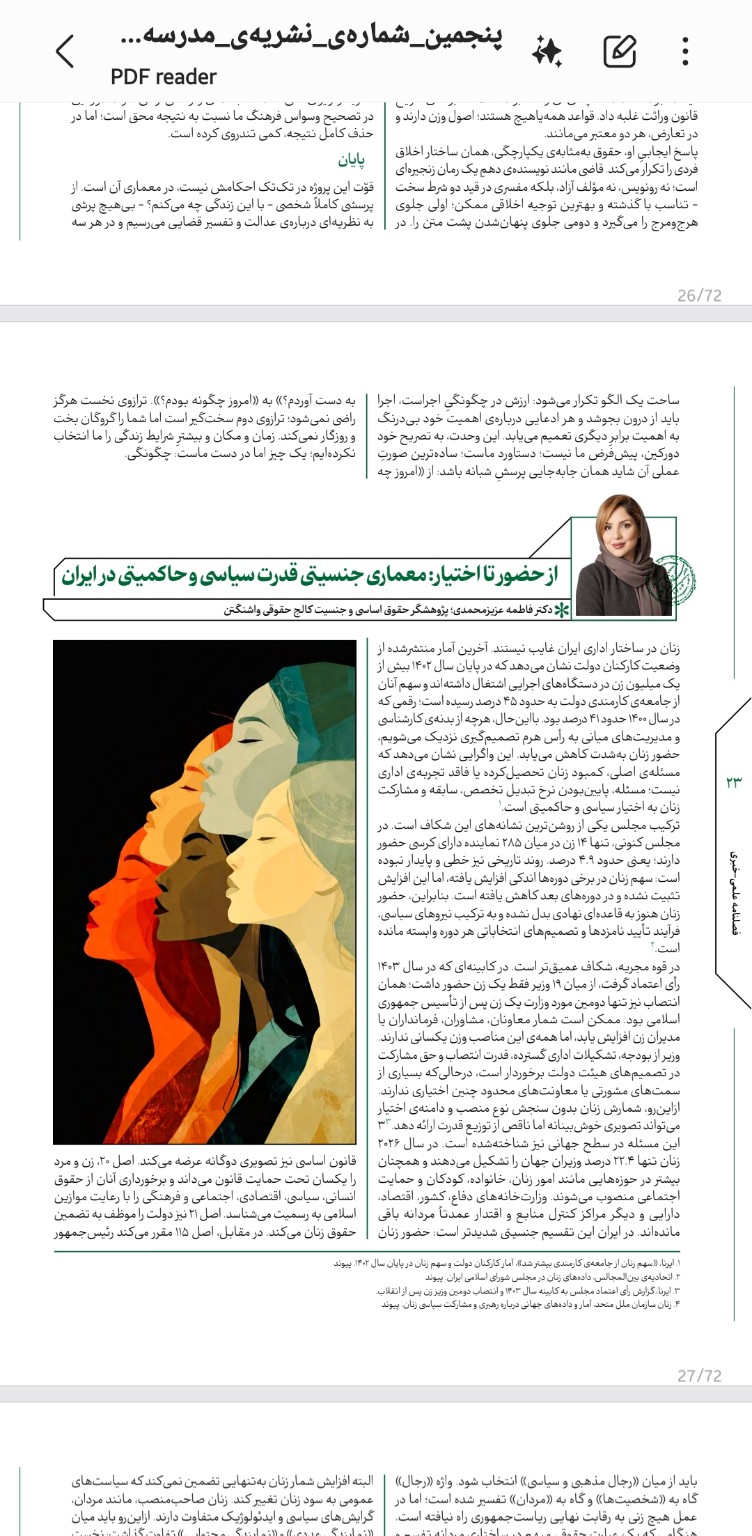
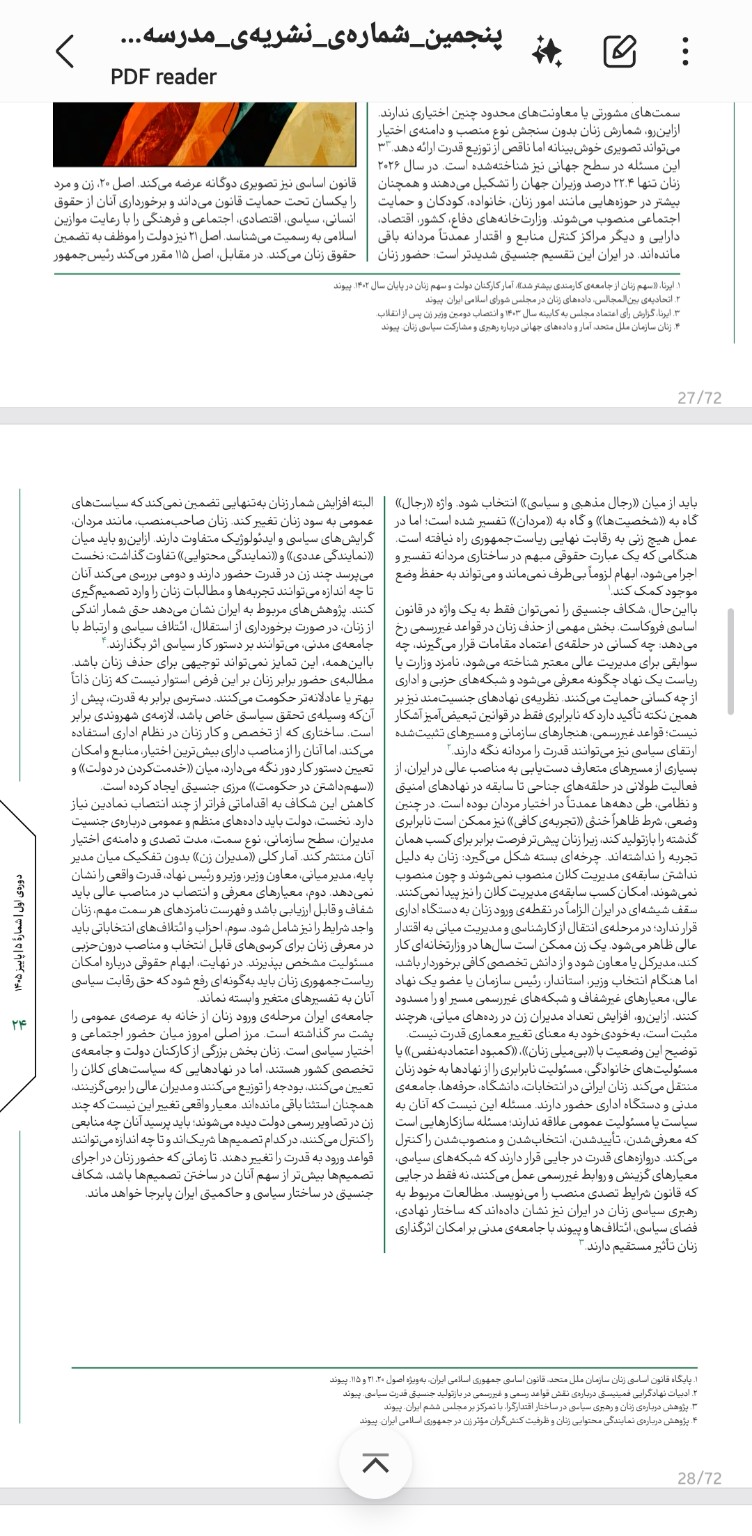
  <p>منتشرشده در فصلنامهٔ علمی–خبری <strong>مدرسهٔ حقوق عمومی</strong>، گروه حقوق عمومی دانشکدهٔ حقوق دانشگاه شهید بهشتی، سال دوم، شمارهٔ پنجم، پاییز ۱۴۰۵، صفحات <strong>۲۳–۲۴</strong>.</p>

  <p>افزایش شمار زنان در نهادهای سیاسی و اداری، به‌تنهایی نشان نمی‌دهد که سهم آنان از قدرت تصمیم‌گیری نیز افزایش یافته است. این یادداشت فاصلهٔ میان حضور عددی، نوع منصب و اختیار واقعی زنان را در ساختار سیاسی و حاکمیتی ایران بررسی می‌کند.</p>

  <p>بحث بر موانعی متمرکز است که تبدیل تحصیلات، تخصص و تجربهٔ زنان به اختیار سیاسی را محدود می‌کنند: قواعد حقوقی و تفسیرهای آن‌ها، مسیرهای انتصاب و ارتقا، تقسیم جنسیتی حوزه‌های مدیریتی و شبکه‌های غیررسمی قدرت. یادداشت همچنین میان «نمایندگی عددی» و «نمایندگی محتوایی» تمایز می‌گذارد؛ حضور زنان زمانی می‌تواند به تغییر سیاست‌ها کمک کند که امکان اثرگذاری بر دستور کار و تصمیم‌ها را داشته باشند.</p>

  <p>پیشنهاد اصلی، سنجش مشارکت زنان بر اساس سطح مسئولیت و دامنهٔ اختیار، همراه با شفافیت انتصاب‌ها، معیارهای قابل ارزیابی و انتشار داده‌های تفکیک‌شده دربارهٔ مناصب عالی است.</p>

  <p><a href="https://t.me/ThepubliclawschoolSBU/241" class="btn btn--primary">مشاهدهٔ شمارهٔ نشریه در کانال مدرسهٔ حقوق عمومی</a></p>

  <h2 id="section">تصاویر نسخهٔ منتشرشده</h2>

  <p>تصاویر زیر همان تصاویر ارسالی از صفحات چاپ‌شده‌اند. برای مشاهده در اندازهٔ اصلی، روی هر تصویر بزنید.</p>

  <p><a href="/images/writing/from-presence-to-authority-page-23.jpg"><img src="/images/writing/from-presence-to-authority-page-23.jpg" alt="صفحهٔ ۲۳ نشریه، آغاز یادداشت از حضور تا اختیار" /></a></p>

  <p><a href="/images/writing/from-presence-to-authority-page-24.jpg"><img src="/images/writing/from-presence-to-authority-page-24.jpg" alt="صفحهٔ ۲۴ نشریه، ادامهٔ یادداشت از حضور تا اختیار" /></a></p>

  <details>
<summary>جلد شمارهٔ پنجم نشریه</summary>
<img src="/images/writing/public-law-school-issue-5-cover.jpg" alt="جلد شمارهٔ پنجم مدرسهٔ حقوق عمومی، پاییز ۱۴۰۵" loading="lazy" style="max-width: 100%; height: auto;" />
</details>

  <p><a href="/writing/from-presence-to-authority/">معرفی انگلیسی این یادداشت</a></p>

</div>]]></content><author><name>Nazanin Azizmohammadi, Ph.D.</name><email>azizmohammadi@dataismlab.com</email></author><category term="writing" /><category term="Gender Equality" /><category term="Constitutional Law" /><category term="Political Representation" /><category term="Iran" /><summary type="html"><![CDATA[از حضور تا اختیار، نوشتهٔ دکتر فاطمه عزیزمحمدی (نازنین)، دربارهٔ معماری جنسیتی قدرت سیاسی و حاکمیتی در ایران، مدرسهٔ حقوق عمومی، شمارهٔ ۵، صفحات ۲۳–۲۴.]]></summary></entry><entry xml:lang="en"><title type="html">From Financial Right to Exit Leverage: An Economic Analysis of Mahr in Iranian Family Law</title><link href="https://nazaninazm.com/writing/mahr-economic-analysis/" rel="alternate" type="text/html" title="From Financial Right to Exit Leverage: An Economic Analysis of Mahr in Iranian Family Law" /><published>2026-09-29T00:00:00+00:00</published><updated>2026-10-22T00:00:00+00:00</updated><id>https://nazaninazm.com/writing/mahr-economic-analysis-en</id><content type="html" xml:base="https://nazaninazm.com/writing/mahr-economic-analysis/"><![CDATA[<p><a class="btn btn--primary" href="/files/writing/mahr-economic-analysis-en.pdf?v=20261022" target="_blank" rel="noopener">Read and download the updated PDF</a></p>

<p class="page__meta">Updated October 22, 2026 · Includes footnotes and a separate reference list</p>

<div lang="en" style="text-align: justify;">

  <p>In Iranian family law, <em>mahr</em> is a financial entitlement owed by the husband to the wife under the marriage contract. This paper examines proposals to reform its enforcement within the broader structure of family law. The debate over “fourteen or 110 coins” does not by itself capture the issue: the economic value of <em>mahr</em> depends on a woman’s access to divorce, income and housing, a share in property acquired during marriage, and effective enforcement of judgments.</p>

  <p>The analysis treats <em>mahr</em> both as a legal financial right and, in the absence of alternative protections, as a limited source of bargaining leverage when a marriage breaks down. Its central conclusion is that structural reform is necessary, but weakening enforcement without creating substitute protections may shift more of the economic risk of divorce onto women.</p>

  <p>The updated paper develops proposals for asset-based enforcement, temporary subsistence support, protective default terms in marriage contracts, and rebuttable presumptions concerning remuneration for domestic and care work. It distinguishes these proposals from existing law and includes 21 footnotes and a bibliography of 24 sources.</p>

</div>]]></content><author><name>Nazanin Azizmohammadi, Ph.D.</name><email>azizmohammadi@dataismlab.com</email></author><category term="writing" /><category term="Mahr" /><category term="Family Law" /><category term="Women&apos;s Economic Rights" /><category term="Iranian Law" /><summary type="html"><![CDATA[An analysis of mahr as a financial right and source of bargaining leverage within Iranian family law, with attention to divorce, enforcement, property, and economic dependency.]]></summary></entry><entry xml:lang="fa"><title type="html">از حق مالی تا اهرم خروج: تحلیل اقتصادی مهریه در حقوق خانواده ایران</title><link href="https://nazaninazm.com/writing/mahr-economic-analysis-fa/" rel="alternate" type="text/html" title="از حق مالی تا اهرم خروج: تحلیل اقتصادی مهریه در حقوق خانواده ایران" /><published>2026-09-29T00:00:00+00:00</published><updated>2026-10-22T00:00:00+00:00</updated><id>https://nazaninazm.com/writing/mahr-economic-analysis-fa</id><content type="html" xml:base="https://nazaninazm.com/writing/mahr-economic-analysis-fa/"><![CDATA[<div dir="rtl" lang="fa" style="direction: rtl; text-align: justify;">

  <p><a class="btn btn--primary" href="/files/writing/mahr-economic-analysis-fa.pdf?v=20261022" target="_blank" rel="noopener">مطالعه و دانلود نسخهٔ به‌روز PDF</a></p>

  <p class="page__meta">به‌روزرسانی: ۲۲ اکتبر ۲۰۲۶ · همراه با پانویس و فهرست مستقل منابع</p>

  <p>این مقاله طرح اخیر اصلاح مقررات مهریه را در بستر گسترده‌تر حقوق خانواده ایران بررسی می‌کند. بحث «چهارده یا صدوده سکه» به‌تنهایی مسئله را توضیح نمی‌دهد؛ ارزش اقتصادی مهریه به امکان طلاق، دسترسی زن به درآمد و مسکن، سهم او از دارایی‌های دوران ازدواج و قابلیت اجرای حکم دادگاه وابسته است.</p>

  <p>تحلیل حاضر مهریه را هم‌زمان به‌عنوان یک حق مالی و، در نبود حمایت‌های جایگزین، یکی از ابزارهای محدود چانه‌زنی هنگام فروپاشی ازدواج مطالعه می‌کند. نتیجه اصلی این است که اصلاح ساختاری ضروری است، اما تضعیف ابزار وصول بدون ایجاد حمایت‌های جایگزین می‌تواند خطر اقتصادی طلاق را بیشتر بر دوش زنان قرار دهد.</p>

  <p>نسخهٔ به‌روز، پیشنهادهای اجرای دارایی‌محور، حمایت معیشتی موقت، شروط حمایتی پیش‌فرض در عقدنامه و اماره‌های قابل رد برای اجرت‌المثل کار خانگی و مراقبتی را توضیح می‌دهد. این پیشنهادها از احکام فعلی قانون تفکیک شده‌اند. مقاله دارای ۲۱ پانویس و فهرست مستقل ۲۴ منبع است.</p>

</div>]]></content><author><name>Nazanin Azizmohammadi, Ph.D.</name><email>azizmohammadi@dataismlab.com</email></author><category term="writing" /><category term="Mahr" /><category term="Family Law" /><category term="Women&apos;s Economic Rights" /><category term="Iranian Law" /><summary type="html"><![CDATA[تحلیلی از مهریه به‌عنوان حق مالی و اهرم چانه‌زنی در ساختار حقوق خانواده ایران، با توجه به طلاق، اجرای حکم، مالکیت و وابستگی اقتصادی.]]></summary></entry><entry xml:lang="en"><title type="html">When Does Employment Actually Redistribute Power?</title><link href="https://nazaninazm.com/writing/when-employment-redistributes-power/" rel="alternate" type="text/html" title="When Does Employment Actually Redistribute Power?" /><published>2026-09-10T00:00:00+00:00</published><updated>2026-09-10T00:00:00+00:00</updated><id>https://nazaninazm.com/writing/when-employment-redistributes-power-en</id><content type="html" xml:base="https://nazaninazm.com/writing/when-employment-redistributes-power/"><![CDATA[<p>Women’s employment is not simply about access to the labour market. The deeper question is whether, and under what conditions, work translates into economic independence and the power to choose.</p>

<p>In <a href="/writing/costly-absence-gender-inequality-economy/"><em>A Costly Absence</em></a>, I examined how gender inequality is not only a matter of justice: excluding women from economic opportunity also diminishes human capital and economic capacity. Yet the language of economic cost has a limitation. It tells us what the economy loses, but not how much agency an individual woman gains or loses.</p>

<p>The World Bank’s <em>Women, Business and the Law 2026</em> examines this issue through legal and institutional indicators. Across 190 economies, the average score for women’s legal rights is 67 out of 100. The average score for supportive frameworks is 47, while the Enforcement Perceptions score is 53. The third measure is sometimes inaccurately described as a direct measurement of actual enforcement. It is instead a perception-based indicator derived from assessments by legal experts concerning implementation by public authorities.</p>

<p>WBL 2026 also introduced a revised methodology. The figure of 67 therefore cannot be placed beside earlier scores without methodological adjustment and then treated as evidence of a trend. To support comparisons over time, the World Bank recalculated historical results under the former method and aligned the 2024 and 2025 data with the 2026 methodology.</p>

<p>This distinction matters legally. The distance between law on the books and law in practice is not always caused only by weak enforcement. Sometimes the legal rule itself restricts women’s economic agency. Article 1117 of the Iranian Civil Code is a clear example: under the conditions stated in the provision, a husband may prevent his wife from pursuing an occupation that he considers incompatible with family interests or with his or her dignity. The effect of the provision cannot be understood from its text alone; judicial practice and the way courts apply it must also be examined.</p>

<p>A recent <em>Economist</em> analysis, “How work makes families more equal,” moves the discussion from the labour market into the household. Its central idea is that employment and independent income can, in some circumstances, increase women’s bargaining power. The relationship, however, is neither linear nor guaranteed.</p>

<p>A 2021 study by Bilge Erten and Pinar Keskin used the arrival of Syrian refugees as an external labour-market shock in Turkey. It found that reduced employment and income opportunities for women were associated with lower intimate-partner violence, particularly among women with less education. The authors considered this finding consistent with theories of instrumental violence. The result should not be generalised to all societies, and it does not establish that women’s employment itself causes violence. It shows that the relationship between income, power, and safety depends on social and household structures.</p>

<p>This is where the reciprocal relationship between law and women’s agency becomes clear. Law can create, restrict, or condition the possibility of economic independence. Economic independence can, in turn, strengthen women’s capacity to negotiate, resist, and demand legal reform. The World Bank estimates that closing gender gaps in employment and entrepreneurship could raise global output by approximately 20 percent.</p>

<p>Under what legal and social conditions does employment actually become the power to choose?</p>

<p>The issue is not simply whether women are permitted to work. It is whether work, within a given legal and institutional structure, gives them greater control over their own lives.</p>

<h3 id="sources">Sources</h3>

<ul>
  <li><em>The Economist</em>, “How work makes families more equal” (3 September 2026).</li>
  <li>World Bank, <em>Women, Business and the Law 2026</em>.</li>
  <li>Bilge Erten &amp; Pinar Keskin (2021), “Female employment and intimate partner violence: Evidence from Syrian refugee inflows to Turkey,” <em>Journal of Development Economics</em>, 150, 102607.</li>
</ul>]]></content><author><name>Nazanin Azizmohammadi, Ph.D.</name><email>azizmohammadi@dataismlab.com</email></author><category term="writing" /><category term="Women&apos;s Employment" /><category term="Gender Equality" /><category term="Economic Agency" /><category term="Iranian Law" /><summary type="html"><![CDATA[A review of Women, Business and the Law 2026 and of the complex relationship between employment, economic independence, bargaining power, and women's safety.]]></summary></entry><entry xml:lang="fa"><title type="html">اشتغال زنان؛ از هزینه اقتصادی تا توزیع قدرت</title><link href="https://nazaninazm.com/writing/womens-employment-power/" rel="alternate" type="text/html" title="اشتغال زنان؛ از هزینه اقتصادی تا توزیع قدرت" /><published>2026-09-10T00:00:00+00:00</published><updated>2026-09-10T00:00:00+00:00</updated><id>https://nazaninazm.com/writing/womens-employment-power</id><content type="html" xml:base="https://nazaninazm.com/writing/womens-employment-power/"><![CDATA[<p><a class="btn btn--primary" href="/files/writing/womens-employment-power-fa.pdf">Download PDF</a></p>

<div dir="rtl" lang="fa" style="direction: rtl; text-align: justify;">

پیش‌تر درباره «غیبت پرهزینه» زنان از بازار کار نوشته بودم؛ اینکه نابرابری جنسیتی فقط مسئله عدالت نیست و محدود کردن زنان از فرصت‌های اقتصادی، بخشی از سرمایه انسانی و ظرفیت رشد را نیز از بین می‌برد. اما قاب «هزینه اقتصادی» یک محدودیت دارد: به ما می‌گوید اقتصاد چه چیزی از دست می‌دهد، نه اینکه خود زن چه میزان اختیار به دست می‌آورد یا از دست می‌دهد.

گزارش Women, Business and the Law 2026 بانک جهانی این مسئله را از زاویه حقوق و نهادها بررسی می‌کند. در ۱۹۰ اقتصاد، میانگین امتیاز حقوق قانونی زنان ۶۷ از ۱۰۰ است؛ امتیاز چارچوب‌های حمایتی و نهادی ۴۷ و امتیاز Enforcement Perceptions، یعنی برداشت کارشناسان از میزان اجرای قوانین توسط مقامات عمومی، ۵۳ از ۱۰۰ است. این ستون سوم، برخلاف آنچه گاهی در بازنشرها دیده می‌شود، اندازه‌گیری مستقیم اجرای واقعی قانون نیست؛ بلکه یک سنجه ادراکی مبتنی بر ارزیابی کارشناسان حقوقی است.

WBL 2026 همچنین با روش‌شناسی تازه‌ای منتشر شده است؛ بنابراین عدد ۶۷ را نمی‌توان بدون تعدیل روش‌شناختی کنار ارقام سال‌های قبل گذاشت و از تفاوت آنها روند استنباط کرد. بانک جهانی برای امکان مقایسه زمانی، هم داده‌های تاریخی را با روش قدیم بازمحاسبه کرده و هم داده‌های ۲۰۲۴ و ۲۰۲۵ را با روش ۲۰۲۶ هم‌تراز کرده است.

این تمایز از منظر حقوقی مهم است. فاصله میان law on the books و law in practice فقط ناشی از ضعف اجرا نیست؛ گاهی خود متن قانون نیز امکان اقتصادی زن را محدود می‌کند. در حقوق ایران، ماده ۱۱۱۷ قانون مدنی نمونه روشنی است: شوهر می‌تواند تحت شرایط مقرر در قانون، زن را از شغلی که منافی مصالح خانوادگی یا حیثیات خود یا زن تشخیص داده می‌شود منع کند. اثر واقعی چنین قاعده‌ای البته فقط با خواندن متن قانون روشن نمی‌شود و بررسی رویه قضایی و نحوه اعمال آن نیز ضروری است.

تحلیل اخیر The Economist با عنوان «How work makes families more equal» بحث را از بازار کار به درون خانواده می‌برد. ایده اصلی این است که اشتغال و درآمد مستقل می‌تواند در برخی زمینه‌ها قدرت چانه‌زنی زنان را افزایش دهد. اما این رابطه خطی و تضمین‌شده نیست.

پژوهش Bilge Erten و Pinar Keskin در سال ۲۰۲۱ درباره ترکیه، با استفاده از ورود پناهجویان سوری به‌عنوان یک شوک بیرونی به بازار کار، نشان داد که کاهش فرصت‌های درآمدی و اشتغال زنان با کاهش خشونت شریک عاطفی همراه بود؛ اثری که عمدتاً در میان زنان با تحصیلات پایین‌تر دیده شد. نویسندگان این یافته را با نظریه‌های «خشونت ابزاری» سازگار می‌دانند. این نتیجه را نباید به همه جوامع تعمیم داد و نشان نمی‌دهد که اشتغال زنان به‌خودی‌خود علت خشونت است؛ بلکه نشان می‌دهد رابطه میان درآمد، قدرت و امنیت به ساختار اجتماعی و خانوادگی وابسته است.

از همین‌جا رابطه دوسویه قانون و عاملیت زنان روشن می‌شود: قانون می‌تواند امکان استقلال اقتصادی را ایجاد، محدود یا مشروط کند؛ و استقلال اقتصادی نیز می‌تواند ظرفیت زنان را برای مذاکره، مقاومت و مطالبه اصلاحات حقوقی افزایش دهد. بانک جهانی برآورد می‌کند که بستن شکاف جنسیتی در اشتغال و کارآفرینی می‌تواند تولید جهانی را حدود ۲۰ درصد افزایش دهد.

در چه ساختار حقوقی و اجتماعی، اشتغال واقعاً به قدرت انتخاب تبدیل می‌شود؟

مسئله فقط این نیست که زنان بتوانند کار کنند؛ مسئله این است که کار، در چه شرایطی، به آنان قدرت انتخاب می‌دهد.

### منابع

- The Economist, “How work makes families more equal” (3 Sep. 2026).
- World Bank, *Women, Business and the Law 2026*.
- Bilge Erten &amp; Pinar Keskin (2021), “Female employment and intimate partner violence: Evidence from Syrian refugee inflows to Turkey,” *Journal of Development Economics*, 150, 102607.

</div>]]></content><author><name>Nazanin Azizmohammadi, Ph.D.</name><email>azizmohammadi@dataismlab.com</email></author><category term="writing" /><category term="Women&apos;s Employment" /><category term="Gender Equality" /><category term="Economic Agency" /><category term="Iranian Law" /><summary type="html"><![CDATA[مروری بر داده‌های Women, Business and the Law 2026 و رابطه پیچیده میان اشتغال، استقلال اقتصادی، قدرت چانه‌زنی و امنیت زنان.]]></summary></entry><entry xml:lang="en"><title type="html">When Women’s Protection Depends on Their ZIP Code</title><link href="https://nazaninazm.com/writing/womens-protection-zip-code/" rel="alternate" type="text/html" title="When Women’s Protection Depends on Their ZIP Code" /><published>2026-08-27T00:00:00+00:00</published><updated>2026-08-27T00:00:00+00:00</updated><id>https://nazaninazm.com/writing/womens-protection-zip-code</id><content type="html" xml:base="https://nazaninazm.com/writing/womens-protection-zip-code/"><![CDATA[<p><a class="btn btn--primary" href="/files/writing/womens-protection-zip-code.pdf">Download PDF</a></p>

<p>On Women’s Equality Day, I read Equality Now’s <em>International human rights law and constitutional equality</em>, published as part of its advocacy on women’s rights in the United States. Its central proposition is direct: equality should be guaranteed in the Constitution, and constitutional protection is necessary if human rights are to be equally enforceable. This note is my independent public-law response. It asks a harder question of constitutional design: in a federal system, who must establish the minimum level of protection, and what happens when constitutional authority is divided among institutions that do not have equal power to act?</p>

<h2 id="from-legal-gaps-to-constitutional-structure">From legal gaps to constitutional structure</h2>

<p>The United States does not lack laws against sex discrimination or gender-based violence. The Equal Protection Clause, federal civil-rights statutes, state criminal laws, family-law rules, protective orders, and administrative programs all provide forms of protection. The difficulty is that these protections do not rest on a single, settled constitutional foundation expressly prohibiting the denial of equality on account of sex. Their scope also varies by subject, remedy, institution, and geography.</p>

<p>Equality Now points to child marriage, female genital mutilation/cutting (FGM/C), online sexual exploitation, and the unsettled position of the Equal Rights Amendment (ERA). These matters are legally distinct, but they expose the same public-law problem: the allocation of authority. Marriage and family law remain principally matters of state law; much ordinary criminal law is also administered by the states. Federal power, by contrast, must be tied to an enumerated constitutional source. As a result, conduct may be prohibited without exception in one state, permitted under specified conditions in another, and addressed by different remedies or enforcement practices elsewhere.</p>

<h2 id="federalism-and-geographical-inequality">Federalism and geographical inequality</h2>

<p>Variation is not itself a constitutional defect. Federalism permits local democratic choice and has allowed some states to adopt stronger protections before national institutions acted. A state may serve as a laboratory for reform. But the same structure can preserve serious differences in protection. When a state border changes a child’s exposure to marriage, a survivor’s access to a civil remedy, or the availability of protective services, legal diversity begins to affect bodily integrity, equality, and access to justice.</p>

<p>The relevant question is therefore not whether every state law must be identical. It is whether certain interests are sufficiently fundamental to require an enforceable national floor. Equality Now effectively answers yes, but identifying the need for a floor does not determine the legal route for creating it. A national rule may depend on constitutional amendment, Congress’s enumerated powers, enforcement legislation under the Reconstruction Amendments, conditional federal spending, or coordinated state reform. These routes are not interchangeable. Each has different limits, remedies, and consequences for federalism.</p>

<h2 id="the-limits-of-congressional-power">The limits of congressional power</h2>

<p><em>United States v. Morrison</em> illustrates the problem. Congress created a federal civil remedy for victims of gender-motivated violence after compiling an extensive record of its nationwide effects. The Supreme Court nevertheless held that the remedy exceeded Congress’s authority under the Commerce Clause and section 5 of the Fourteenth Amendment. Non-economic violent conduct could not be aggregated into interstate commerce merely because of its national consequences, and the Fourteenth Amendment generally regulates state action rather than purely private conduct.</p>

<p>The federal FGM/C statute faced a related objection in <em>United States v. Nagarwala</em>, where a district court held that the 1996 prohibition exceeded Congress’s enumerated powers. Congress later enacted the STOP FGM Act of 2020, revising the statute and grounding it more expressly in interstate commerce. Whatever view one takes of the earlier decision, the episode shows why the existence of serious harm does not by itself establish federal competence. A legally sound proposal must identify the source of congressional authority and distinguish between measures Congress may require and reforms it may encourage through funding, coordination, or incentives.</p>

<h2 id="equal-protection-and-the-era">Equal protection and the ERA</h2>

<p>The Fourteenth Amendment does not expressly name sex, but the Supreme Court has developed substantial protection against sex discrimination under the Equal Protection Clause. Sex-based classifications ordinarily receive intermediate scrutiny; in <em>United States v. Virginia</em>, the Court required an “exceedingly persuasive justification.” This doctrine matters, yet it remains distinct from strict scrutiny and depends on judicial interpretation of the classification, the government’s objective, and the fit between means and ends.</p>

<p>The ERA would change the textual foundation by providing that equality of rights shall not be denied or abridged on account of sex and by granting Congress enforcement power. Its present status, however, remains contested. Thirty-eight states have voted to ratify it, and advocates maintain that Article V’s numerical requirement has been satisfied. In December 2024, the National Archives stated that the amendment could not then be certified or published because of established legal and procedural decisions concerning the ratification deadline. President Biden subsequently declared in January 2025 that the ERA was the Twenty-Eighth Amendment, but that declaration did not settle the legal dispute. It would therefore be inaccurate either to treat the ERA as unquestionably part of the Constitution or to describe the movement for its recognition as legally insignificant.</p>

<p>It is also premature to assume that recognition of the ERA would automatically produce strict scrutiny in every sex-equality case or resolve every dispute concerning reproductive rights. The amendment would provide a clearer constitutional text and a new enforcement basis for Congress; its precise doctrinal consequences would still be developed through legislation and adjudication.</p>

<h2 id="international-standards-and-domestic-enforceability">International standards and domestic enforceability</h2>

<p>Equality Now is strongest when it identifies the inconsistency between American advocacy abroad and uneven protection at home. The United States regularly urges other governments to prohibit child marriage, prevent FGM/C, and strengthen legal equality, while it has not ratified CEDAW or the Convention on the Rights of the Child. The Human Rights Committee has also called on the United States to strengthen protection against sex and gender discrimination.</p>

<p>Still, international responsibility and domestic enforceability should not be collapsed. The United States is a party to the ICCPR subject to reservations, understandings, and declarations, including a declaration that its substantive provisions are not self-executing. International obligations can guide interpretation, reporting, and political accountability without automatically creating a privately enforceable federal claim. Nor does international law always prescribe a single institutional form of compliance. Constitutional text matters, but statutory rights, judicial remedies, administrative capacity, and state implementation determine whether equality can be claimed in practice.</p>

<h2 id="a-public-law-conclusion">A public-law conclusion</h2>

<p>Equality Now’s intervention identifies a real constitutional vulnerability: important protections remain dispersed across judicial doctrine, federal statutes, state law, and contested constitutional claims. But a public-law analysis must go beyond the statement that equality belongs in the Constitution. It must ask which institution has authority to act, against whom a right may be enforced, what remedy follows, and how a national minimum can coexist with legitimate state autonomy.</p>

<blockquote>
  <p>Federalism is a method of distributing public power. It should not become a method of distributing fundamental rights unequally. The central test is whether the constitutional system can guarantee every woman and girl a coherent, enforceable minimum of protection, regardless of the state in which she lives.</p>
</blockquote>

<h3 id="selected-authorities">Selected authorities</h3>

<p>Equality Now, <em>The Equal Rights Amendment: Equality in the U.S. Constitution</em> (updated 2025); <em>United States v. Virginia</em>, 518 U.S. 515, 531–34 (1996); <em>United States v. Morrison</em>, 529 U.S. 598, 617–27 (2000); <em>United States v. Nagarwala</em>, 350 F. Supp. 3d 613, 629–31 (E.D. Mich. 2018); STOP FGM Act of 2020, 18 U.S.C. § 116; National Archives, <em>Statement on the Equal Rights Amendment Ratification Process</em> (Dec. 17, 2024); Human Rights Committee, <em>Concluding Observations on the Fifth Periodic Report of the United States</em>, CCPR/C/USA/CO/5, paras. 18–19 (2023).</p>]]></content><author><name>Nazanin Azizmohammadi, Ph.D.</name><email>azizmohammadi@dataismlab.com</email></author><category term="writing" /><category term="Constitutional Equality" /><category term="Federalism" /><category term="Women&apos;s Rights" /><category term="Public Law" /><summary type="html"><![CDATA[A public-law response to Equality Now's case for constitutional equality, examining federalism, congressional power, the ERA, and the need for an enforceable national minimum of protection.]]></summary></entry><entry xml:lang="fa"><title type="html">غیبت پرهزینه؛ نابرابری جنسیتی و ناکارآمدی حقوقی در اقتصاد</title><link href="https://nazaninazm.com/writing/costly-absence-gender-equality-economy/" rel="alternate" type="text/html" title="غیبت پرهزینه؛ نابرابری جنسیتی و ناکارآمدی حقوقی در اقتصاد" /><published>2026-07-30T00:00:00+00:00</published><updated>2026-07-30T00:00:00+00:00</updated><id>https://nazaninazm.com/writing/costly-absence-gender-equality-economy</id><content type="html" xml:base="https://nazaninazm.com/writing/costly-absence-gender-equality-economy/"><![CDATA[<p><a class="btn btn--primary" href="/files/writing/costly-absence-fa.pdf">Download PDF</a></p>

<div dir="rtl" lang="fa" style="direction: rtl; text-align: justify;">

بحث حقوق زنان در دهه‌های اخیر دچار تحولی بنیادین شده است. اگر در گذشته تمرکز اصلی بر حمایت‌های حداقلی و رفع تبعیض‌های آشکار بود، امروز یکی از مهم‌ترین میدان‌های این بحث، فضای کسب‌وکار و اقتصاد است؛ حوزه‌ای که در آن نابرابری جنسیتی نه‌تنها نقض یک حق بنیادین، بلکه عاملی ساختاری در تضعیف توسعه پایدار، حکمرانی شرکتی و کارایی بازار محسوب می‌شود.

توانمندسازی زنان در کسب‌وکار دیگر یک مطالبه صرفاً اخلاقی یا اجتماعی نیست، بلکه به‌طور فزاینده‌ای به‌عنوان یک ضرورت حقوقی و اقتصادی مطرح می‌شود. از منظر حقوق بشر، مشارکت برابر در حیات اقتصادی بخشی جدایی‌ناپذیر از کرامت انسانی است. اسناد بین‌المللی، به‌ویژه کنوانسیون رفع کلیه اشکال تبعیض علیه زنان (CEDAW)، دولت‌ها را متعهد می‌کند که موانع قانونی و ساختاری مشارکت اقتصادی زنان را شناسایی و رفع کنند.

با این حال، چالش اصلی در سطح اجراست؛ جایی که شکاف میان «برابری حقوقی» و «برابری واقعی» آشکار می‌شود. وجود قواعد خنثی در ظاهر، لزوماً به نتایج برابر منجر نمی‌شود، به‌ویژه زمانی که ساختارهای بازار و شرکت‌ها خود بازتولیدکننده نابرابری باشند.

داده‌های آماری این شکاف را به‌روشنی نشان می‌دهد. گزارش‌های نهادهایی مانند World Bank و World Economic Forum حاکی از آن است که نرخ مشارکت اقتصادی زنان در اغلب کشورها به‌طور معناداری پایین‌تر از مردان است و این فاصله، حتی در اقتصادهای پیشرفته، به‌سرعت بسته نمی‌شود. اهمیت این آمار صرفاً در توصیف وضعیت نیست؛ بلکه در پیامدهای حقوقی و اقتصادی آن نهفته است. حذف یا حاشیه‌راندن نیمی از سرمایه انسانی، به معنای پذیرش بازاری ناقص و نظام حقوقی ناکارآمد است.

در این نقطه، حقوق شرکت‌ها و حقوق کسب‌وکار نقش محوری پیدا می‌کند. شرکت‌ها صرفاً واحدهای اقتصادی خنثی نیستند؛ بلکه نهادهایی حقوقی‌اند که تصمیمات آن‌ها درباره استخدام، ارتقای شغلی، دستمزد و ترکیب هیأت‌مدیره، آثار مستقیم بر توزیع فرصت و قدرت دارد.

پژوهش‌های تطبیقی نشان داده‌اند شرکت‌هایی که از تنوع جنسیتی در سطوح مدیریتی برخوردارند، نه‌تنها از منظر عدالت اجتماعی، بلکه از حیث عملکرد مالی، مدیریت ریسک و شفافیت حکمرانی نیز نتایج بهتری دارند. این یافته‌ها، از جمله در گزارش‌های OECD، بارها مورد تأکید قرار گرفته است. برخی نظام‌های حقوقی، به‌ویژه در اروپا، با مداخله فعال قانون‌گذار تلاش کرده‌اند این شکاف را کاهش دهند. وضع قواعد الزام‌آور یا نیمه‌الزام‌آور درباره حضور زنان در هیأت‌مدیره شرکت‌های بزرگ، نمونه‌ای از این رویکرد است.

برخلاف انتقادهای اولیه مبنی بر تعارض این سیاست‌ها با اصل شایسته‌سالاری، شواهد نشان می‌دهد که چنین مداخلاتی نه‌تنها کیفیت تصمیم‌گیری را کاهش نداده، بلکه با افزایش تنوع دیدگاه‌ها، از پدیده «تفکر گروهی» جلوگیری کرده و پاسخ‌گویی نهادی را تقویت کرده است. این تجربه‌ها نشان می‌دهد که حقوق می‌تواند، در صورت طراحی هوشمندانه، نقشی اصلاحی و کارآمد ایفا کند.

از منظر حقوق اقتصادی، توانمندسازی زنان ارتباط مستقیمی با رشد و بهره‌وری دارد. اقتصاددانان توسعه بارها نشان داده‌اند که افزایش مشارکت اقتصادی زنان می‌تواند تولید ناخالص داخلی را به‌طور قابل توجهی افزایش دهد. در این چارچوب، حقوق دیگر صرفاً ابزار حمایت از گروه‌های به‌حاشیه‌رانده‌شده نیست، بلکه به‌عنوان زیرساختی برای کارکرد بهینه بازار عمل می‌کند. نادیده‌گرفتن این پیوند، به معنای تقلیل حقوق به مجموعه‌ای از قواعد انتزاعی و جدا از واقعیت‌های اقتصادی است.

با این حال، باید از ساده‌سازی پرهیز کرد. توانمندسازی زنان در کسب‌وکار صرفاً با اعطای فرصت‌های نمادین یا سیاست‌های نمایشی محقق نمی‌شود. اگر قوانین کار انعطاف‌پذیری لازم را نداشته باشند، اگر دسترسی به منابع مالی و اعتباری به‌طور ساختاری نابرابر باشد، و اگر مسئولیت‌های مراقبتی همچنان به‌شکل نامتقارن بر دوش زنان باقی بماند، برابری حقوقی به نتیجه ملموس نخواهد رسید.

در اینجا مفهوم «برابری ماهوی» اهمیت می‌یابد؛ مفهومی که به‌جای رفتار یکسان، بر رفع موانع ساختاری تأکید دارد. نقش دادگاه‌ها و نهادهای نظارتی نیز در این میان قابل توجه است. تفسیر پویا از اصول منع تبعیض، حمایت مؤثر از دعاوی مرتبط با نابرابری جنسیتی در محیط کار، و تشویق شرکت‌ها به شفافیت در سیاست‌های تنوع و برابری، می‌تواند به تدریج هنجارهای بازار را تغییر دهد. حقوق، در این معنا، نه صرفاً بازتاب‌دهنده واقعیت اجتماعی، بلکه شکل‌دهنده آن است.

در نهایت، توانمندسازی زنان در فضای کسب‌وکار را باید بخشی از پروژه بزرگ‌تر حاکمیت قانون، حکمرانی خوب و توسعه پایدار دانست. مسئله اصلی دیگر این نیست که آیا برابری جنسیتی مطلوب است یا نه؛ بلکه این است که نظام‌های حقوقی تا چه حد آمادگی دارند هزینه‌های اقتصادی و نهادی تداوم نابرابری را بپذیرند. در جهانی که رقابت، نوآوری و کارایی معیار بقاست، نادیده‌گرفتن ظرفیت زنان نه محافظه‌کاری است و نه سنت‌گرایی، بلکه نوعی چشم‌پوشی پرهزینه از عقلانیت حقوقی و اقتصادی است.

</div>]]></content><author><name>Nazanin Azizmohammadi, Ph.D.</name><email>azizmohammadi@dataismlab.com</email></author><category term="writing" /><category term="Gender Equality" /><category term="Women&apos;s Economic Participation" /><category term="Business Law" /><category term="Public Law" /><summary type="html"><![CDATA[تحلیلی حقوقی و اقتصادی از شکاف میان برابری صوری و برابری واقعی، و نقش قانون، شرکت‌ها و نهادهای نظارتی در مشارکت اقتصادی زنان.]]></summary></entry></feed>