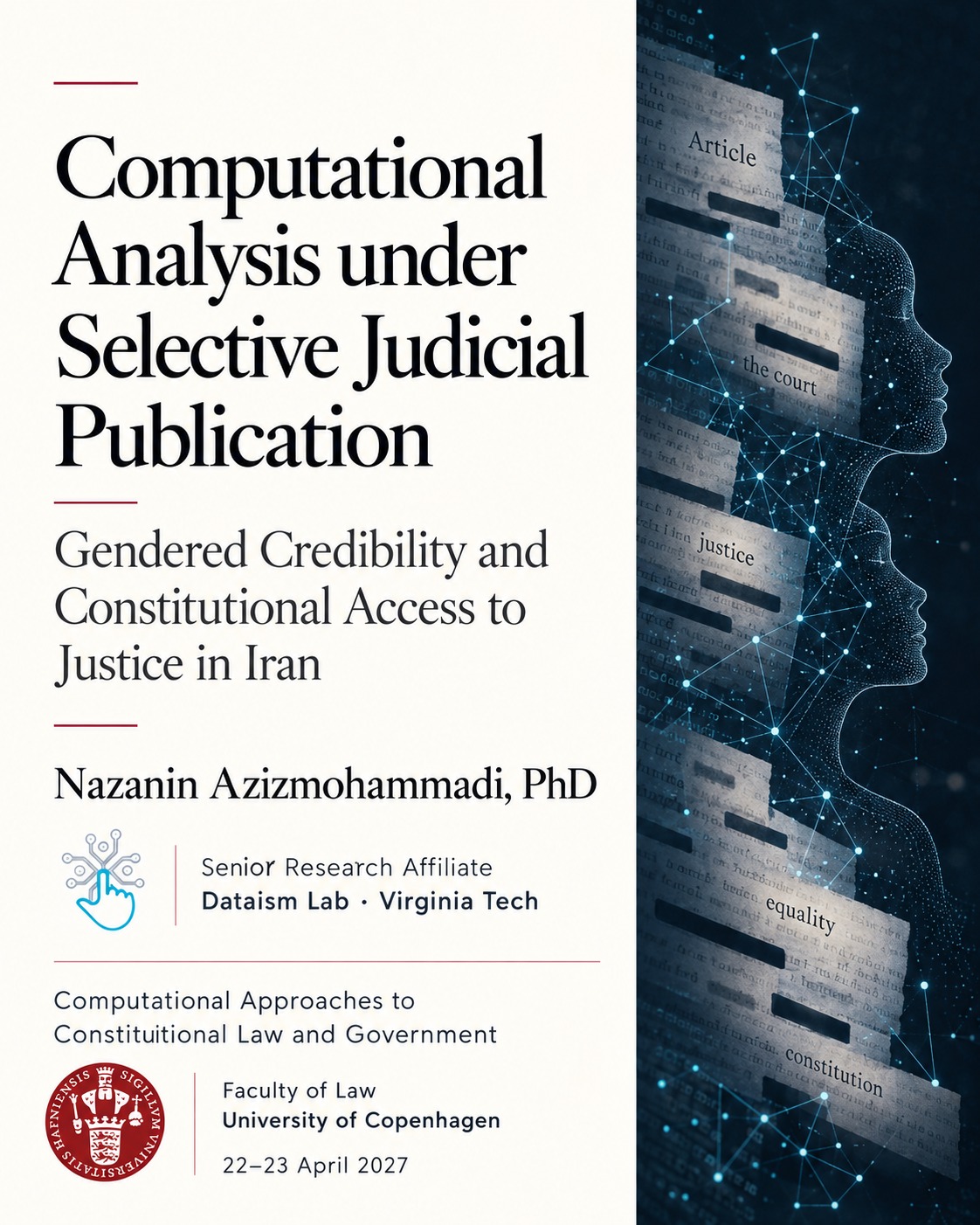
This paper examines how women’s accounts of sexual violence acquire, retain, or lose credibility in judicial reasoning. Focusing on officially published Iranian decisions concerning rape allegations and related sexual-conduct charges, it asks how a complainant’s narrative is translated into legally significant categories and whether computational analysis can help identify gendered patterns in that process. The constitutional question concerns access to justice: whose account receives serious consideration, which experiences become legally recognisable, and how evidentiary uncertainty is allocated between the person seeking protection and the institutions deciding her claim.
The project treats credibility as a question requiring close examination of the reasoning expressed in a judgment. It asks which statements the court accepts, doubts, or leaves unresolved; what reasons it gives for doing so; and how those assessments relate to the legal classification of the alleged conduct. The inquiry will distinguish an explicit assessment of credibility from an inference supplied by a reader or a language model. This distinction matters because a decision may reject a particular allegation without explaining whether the court considered the complainant dishonest, mistaken, insufficiently corroborated, or unable to satisfy the applicable evidentiary threshold.
A central concern is the distinction between failure to establish coercion and an affirmative finding of consent. The project will examine how these propositions are expressed in the selected decisions and whether they remain separate in computational interpretation. It will also distinguish the rejection of a rape allegation from a determination concerning other sexual conduct. The analysis asks when the reasoning moves between these categories, what textual support exists for that movement, and how the complainant’s procedural position changes. These are questions for investigation within the corpus, rather than findings assumed in advance.
The study uses a bounded collection of officially published judicial decisions. Because publication is selective, the collection cannot establish the national prevalence of a reasoning pattern or provide a complete account of how Iranian courts handle sexual-violence complaints. Unpublished cases, omitted procedural details, and the selection of particular decisions affect what researchers can observe. The project therefore treats the production of the public judicial record as part of its methodology. Claims will remain tied to the decisions examined, with a distinction between identifying an interpretive mechanism and estimating how often it occurs.
Methodologically, the project combines expert legal coding with analysis by a Persian-capable large language model. A legal codebook will guide the identification of allegations, assessments of evidence, statements about credibility, legal classifications, and procedural outcomes. An expert-coded benchmark will be used to evaluate the model’s classifications and interpretations. The analysis will attend to who is speaking in a passage: a complainant, an accused person, a lower court, or a reviewing court. Statements reported within a judgment will not automatically be treated as the deciding court’s own conclusions.
Validation will examine category-level accuracy alongside the substance of interpretive errors. The project will test whether changing prompts alters the model’s treatment of legally significant passages and whether translation changes distinctions preserved in the Persian text. Errors involving consent, coercion, credibility, or the attribution of judicial statements will receive qualitative examination. The purpose is to establish the conditions under which computational assistance can support legal analysis, including the points at which an apparently coherent output requires correction or cannot sustain the proposed interpretation.
The paper connects feminist legal inquiry with constitutional access to justice and computational legal research. Its intended contribution is a method for examining gendered credibility that keeps the complainant’s legal position, the judgment’s reasoning, and the limitations of the available record in view. It will assess what language-model analysis can reliably identify, what remains dependent on expert interpretation, and how selective publication shapes the resulting knowledge. It also treats corpus construction, coding, and translation as choices that influence the legal questions researchers can answer, rather than neutral preparatory steps.
View paper details and workshop information